01 · Prepare the visit
Agree on access, who is responsible for the palms, and how observations will be shared. Map the area using simple site codes rather than publicly identifying sensitive locations. Record the visit date, observer, recent work and any known previous findings.
- Bring a notebook or field log, camera, measuring reference and suitable protective clothing.
- Keep climbing, chainsaw work and crown access with trained personnel.
- Choose repeatable photo positions and label each palm and material pile.
02 · Recognize and confirm
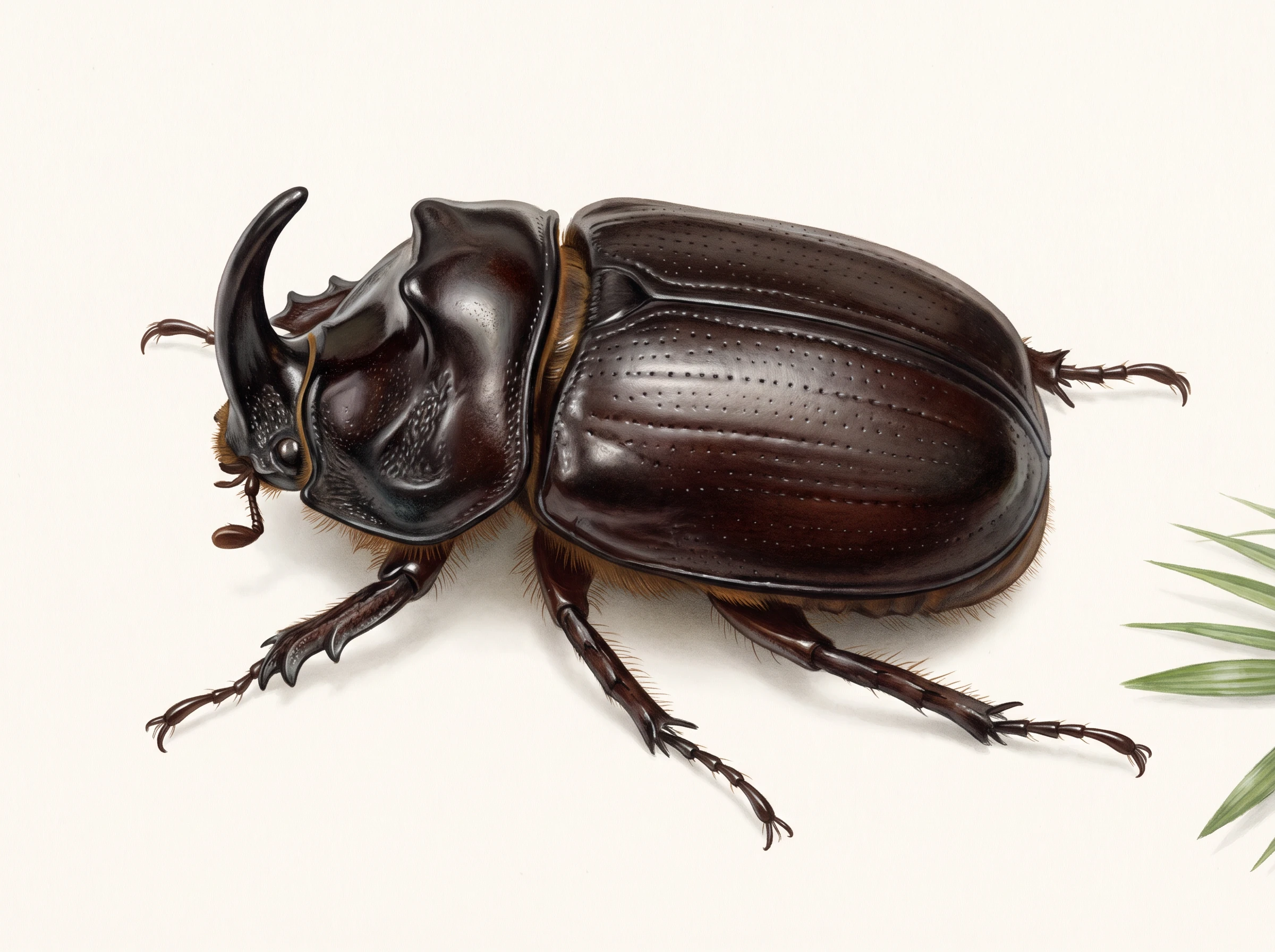
Adults are large, dark beetles with a horn; larvae are pale grubs associated with decaying organic material. Similar-looking beetles and grubs occur in Hawaiʻi. Photograph the organism with a scale and record the material and exact location where it was found. Treat appearance as a reason to seek confirmation.
Use the report form on this website to share the observation with our community team. A submitted record remains suspected until its identification is confirmed; it is not automatically sent to government.
- Record adults, larvae and damage separately.
- Do not use an AI illustration, one leaf notch or size alone as proof of identification.
- Follow the response team’s instructions before transporting specimens.
03 · Map damage and breeding material
Inspect palms from a safe position and note newly visible feeding damage separately from older damage. Adult feeding and larval breeding occur in different places; inspect decaying trunks, stumps, mulch and compost as well as the palms.
- Use the same palm IDs and views on each visit.
- Record material type, approximate amount, moisture conditions and observed life stages.
- Record “not inspected” separately from “inspected, none observed.” A missed detection is possible.
Source: CRB Response — Recognizing CRB and look-alikes · Pacific Community — CRB management manual, second edition (2026)
04 · Interrupt movement pathways
Before ordering mulch, moving green waste or accepting plant material, ask where it came from and how it was handled. Keep a delivery record and avoid redistributing suspect material while seeking local response guidance. A clean-looking load does not establish freedom from eggs or larvae.
- Identify the person who can pause a delivery or outgoing load.
- Record origin, destination, inspection date and any treatment documentation.
- Ask the receiving program about current movement requirements for your island.
Source: Pacific Community — CRB management manual, second edition (2026)
05 · Plan management of breeding material
Physical methods must match the material and the life stages present. Chipping suitable whole material and controlled heat processes are discussed in official guidance; equipment, complete exposure and reinfestation determine the result. Turning a pile, covering it or allowing it to dry is not automatically a validated kill process.
- Use the linked current technical process with a competent operator.
- Record process conditions, cold spots, timing and who verified them.
- Plan storage after treatment; material can become suitable for breeding again.
06 · Assess protection and ecological effects
Where physical palm protection is appropriate, plan installation, repeated inspection and removal together. UH describes netting as a maintained physical tool. Avoid presenting capture counts as proof of reduced palm damage.
- Use trained help for crown access and check the current specifications.
- Record net condition and any non-target entanglement; act promptly when problems occur.
- Compare new damage over time using the same assessment method.
Source: UH Cooperative Extension — Netting for Physical IPM of CRB
07 · Separate biological research from a local recommendation
The SPC manual covers biological approaches used in Pacific settings, including Oryctes rhinoceros nudivirus and Metarhizium fungi. Results depend on the organism or isolate, host population, environment and study design. A regional protocol does not establish that an import, culture, product or use is authorized in Hawaiʻi.
- Check species and isolate, viability, study setting and measured endpoint.
- Read limitations and local applicability before treating a published method as advice.
- Use the research library to distinguish laboratory mortality, field suppression and palm outcomes.
Source: CRB Response — Integrated pest management · Pacific Community — CRB management manual, second edition (2026)
08 · Return, compare and revise
Set the next visit before leaving. Use the same route, records and palm identifiers so changes can be interpreted. Document what changed, what did not, and other explanations such as weather, new deliveries or different observation effort.
- Track new damage and live stages, not only trapped or dead beetles.
- Record labor, cost, non-target effects and practical failures alongside benefits.
- Share an anonymized summary with caretakers, agree on the next action and preserve the original field record.
09 · Build a community record responsibly
Ask permission before recording or publishing a practitioner’s knowledge. Credit knowledge holders on their terms and allow restrictions on location, images or details. Do not label an unreviewed technique as an Indigenous practice, or equate a scientific data gap with lack of value.
- Keep community observations distinct from replicated trials.
- Have the internal team review cultural context, language and attribution.
- Name uncertainty plainly and update the guide when stronger evidence arrives.
Sources & further reading
External sources may discuss methods outside our nonchemical scope. Check the original methods and limitations.
- CRB Response — Recognizing CRB and look-alikes
Use verified photographs and expert identification; editorial artwork is not diagnostic.
- CRB Response — Breeding material treatments
Physical methods and limitations. External source also discusses chemical treatments outside this guide’s scope.
- CRB Response — Integrated pest management
Regional biological-control context and current availability; check again before an intervention.
- Pacific Community — CRB management manual, second edition (2026)
Pacific regional reference. Local authorization and applicability must be checked separately.
- UH Cooperative Extension — Netting for Physical IPM of CRB
Physical protection requires proper placement, maintenance and non-target safeguards.