01 · Start with the right question
Are you checking a new delivery, investigating a possible infestation or comparing repeat surveys? Write that question in the field log before choosing locations. Seek access permission and agree how the result will be communicated.
- Use site codes and a simple map.
- Record the date, weather, observer and survey method.
- Arrange sampling and submission instructions with the identification service.
02 · Recognize suspicion, then confirm
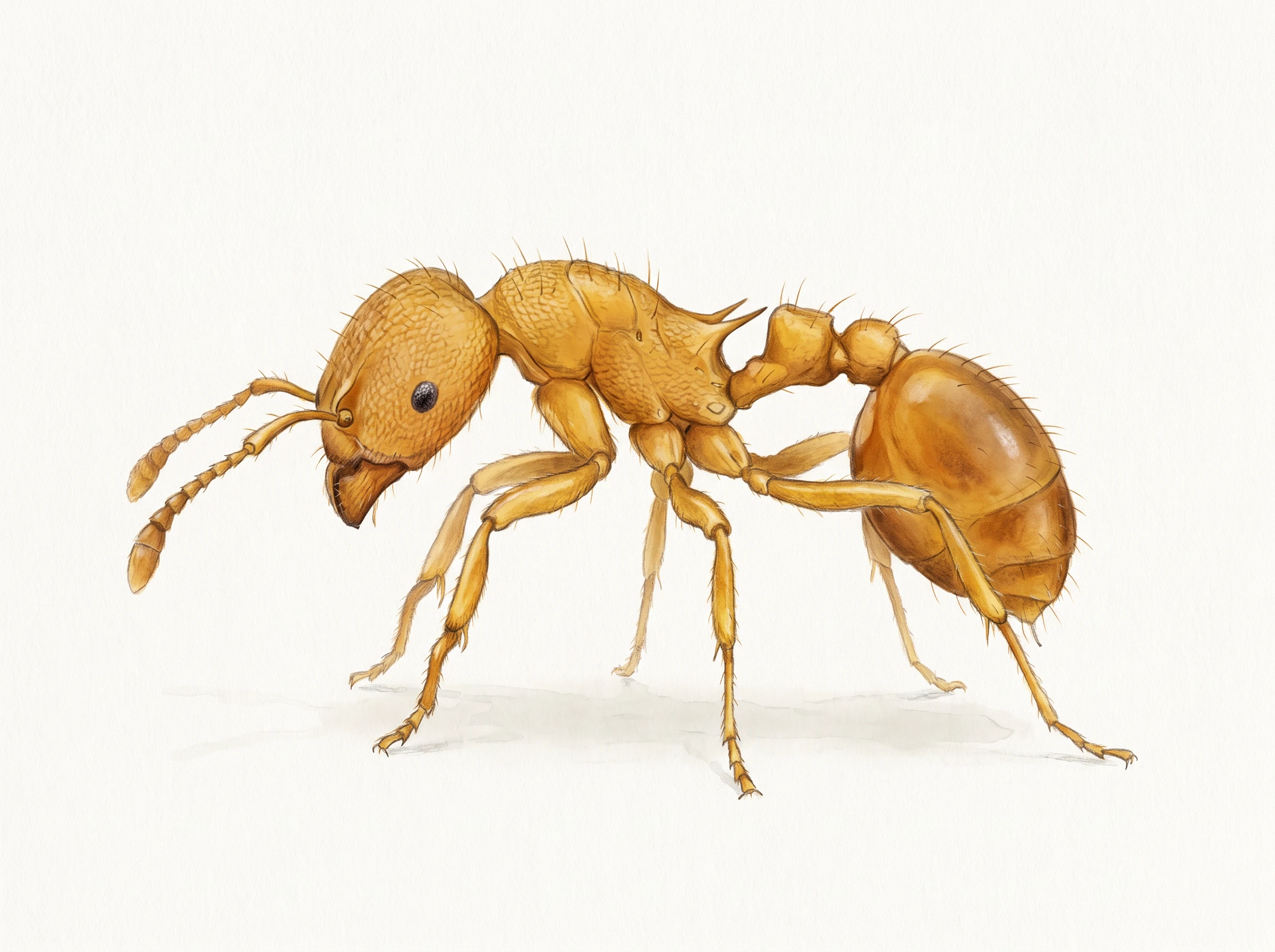
Little fire ant workers are tiny, commonly orange to light brown, and can be confused with other ants. A sting, phone photograph or color match does not provide a reliable species determination. A qualified identifier examines diagnostic features on a specimen.
- Keep the sample location and collection date with the sample.
- Use a verified identification photograph for comparison, not editorial artwork.
- Search historical studies under Wasmannia auropunctata; current taxonomic usage should be checked with the lab.
Source: Hawaiʻi Ant Lab — Identification · Hawaiʻi Ant Lab — Same Ant, New Name
03 · Survey ground and vegetation
Little fire ants can occupy both ground-level spaces and vegetation. Hawaiʻi Ant Lab’s survey uses small food lures, followed by collection for identification. Its current guidance describes a thin peanut-butter layer on sticks in shaded locations, including vegetation, with collection after about an hour. Consult the complete instructions for spacing, handling and submission.
- If food allergies or site restrictions apply, ask the lab for an appropriate alternative.
- Keep samples associated with mapped locations; label before collection.
- Use the lab’s current instructions to secure and prepare samples. Do not mail live ants.
Source: Hawaiʻi Ant Lab — Survey instructions · Hawaiʻi Ant Lab — Biology and ecology
04 · Interpret a survey honestly
A positive identification establishes the species in the collected sample. A negative visit means it was not detected by that survey; it does not guarantee that every part of a property is free of ants. Record inaccessible areas and conditions that may have affected detection.
- Map each sampled point and retain the identification result.
- Compare the same method and locations over time.
- Ask the identification team about repeat sampling when a result is uncertain.
05 · Prevent transport with plants and materials
Small colony fragments can travel with infested items. Check potted plants, cuttings, soil, mulch and equipment before moving them between sites. Keep suspect items from being distributed while arranging identification and a response plan. A holding area by itself is not a proven containment treatment.
- Keep incoming batches identifiable and record the supplier and date.
- Avoid mixing an unchecked batch with material intended for distribution.
- Coordinate with neighbors and material suppliers; property boundaries do not define colony boundaries.
06 · Understand nonchemical research limits
Hara and colleagues tested controlled hot-water treatments on nursery plants. Their results included surviving ants and did not establish a stand-alone quarantine protocol. Those nursery results should not be converted into a home recipe or a claim of whole-property eradication.
- Separate ant survival from plant tolerance and worker safety.
- Look for confirmed queen and colony outcomes, not just exposed worker mortality.
- Do not assume a fungal result for CRB or a different ant species applies to little fire ant.
07 · Compare evidence before adopting a claim
For each paper, identify the species, study location, treatment, comparison and endpoint. Laboratory studies help explain mechanisms; field studies are needed to test performance in the setting where a method will be used. Funding announcements and product descriptions are different kinds of evidence.
- Use the library’s topic and evidence labels to find the relevant material.
- Record duration, sample size, adverse effects and limitations.
- Keep an unanswered question open rather than replacing it with an efficacy claim.
08 · Follow up with your community
Keep a dated record of sample results and any response actions. Compare repeat surveys with the baseline and share findings in a way that protects household privacy. Do not declare eradication from a single negative result.
- Assign a person to follow up with the lab or response program.
- Keep access and cultural permissions with the record.
- Discuss where monitoring should continue and what evidence would justify changing the plan.
Sources & further reading
External sources may discuss methods outside our nonchemical scope. Check the original methods and limitations.
- Hawaiʻi Ant Lab — Identification
Small orange ants have look-alikes. Submit specimens for identification.
- Hawaiʻi Ant Lab — Survey instructions
Sampling and identification guidance. External page includes chemical information outside this guide’s scope.
- Hawaiʻi Ant Lab — Biology and ecology
Colony structure, habitats and movement pathways.
- Hara et al. (2011) — Hot-water and bait trials
Controlled nursery trials do not establish landscape eradication. The paper also evaluates insecticides; those are not recommendations here.
- Hawaiʻi Ant Lab — Research bibliography
Use species, study setting and measured outcomes to evaluate relevance.
- Hawaiʻi Ant Lab — Same Ant, New Name
Check current taxonomy; historical literature remains indexed under Wasmannia auropunctata.